
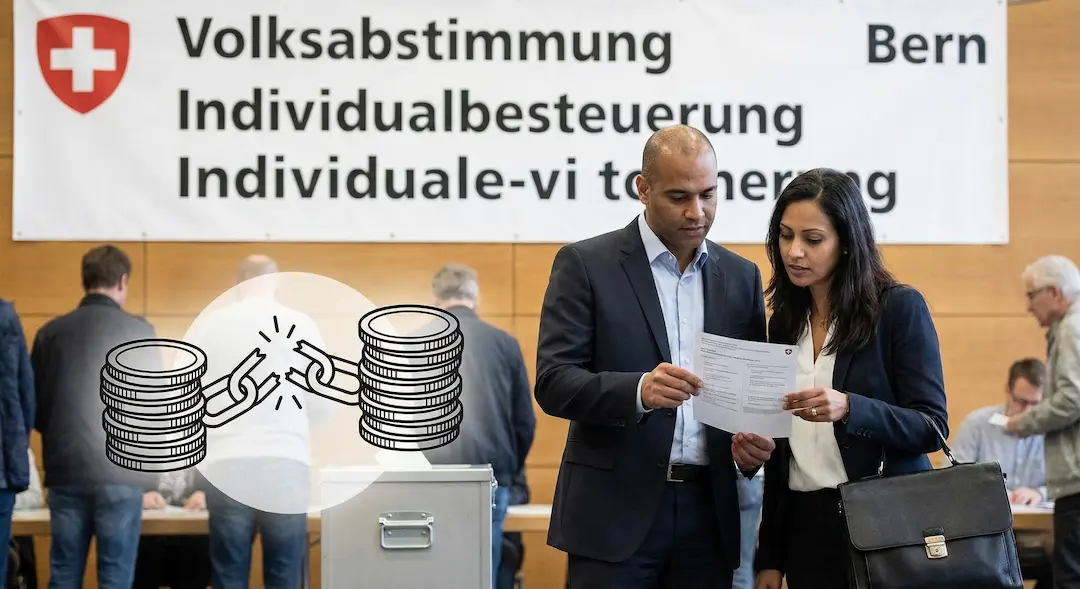
On March 8 2026, Switzerland voted to end the marriage penalty.
Discover what the 2026 individual taxation reform means for your expat household, and how you can strategically deploy your unallocated bonuses to protect your wealth before the new laws take effect.
“You may please some of the people all of the time, You may please all of the people some of the time, But you cannot please all of the people all of the time.” — Lydgate, Fall of the Princes
Following the historic vote on 8 March 2026, where Switzerland approved the independent taxation reform by a 54% majority, it is clear how personal the country’s marriage tax debate has become.
Consider a recent conversation with an expat who married in 2017 and typically earns about 30% more than his wife in a good income year. When she voted in favour of individual taxation, she joked that if the reform failed, they might as well get divorced. By her estimate, the couple had paid around CHF 100,000 in the so-called “marriage penalty” over just nine years.
It is an understandable frustration. Today, married couples in Switzerland are taxed jointly, meaning a second income is stacked on top of the first and taxed at a much higher marginal rate. However, a single tax figure overlooks the other realities of family life, not least the substantial cost of childcare. Like many households, finances are shaped by far more than a single tax bracket.
With the reform officially passing, Switzerland will transition closer to the individual-based taxation models used in countries such as the UK or the US (where taxpayers can choose “married filing separately”). Each adult will file and pay taxes individually, regardless of marital status.
Household Structure | Likely Impact | Reason |
Dual-Earner Couples (Similar Incomes) | Winner (Lower Tax) | Elimination of the progressive tax penalty on combined high incomes. |
Unmarried Couples with Children | Winner (Lower Tax) | Equalised tax rates and access to higher child deductions. |
Single-Earner Married Couples | Loser (Higher Tax) | Loss of the current ‘married persons’ rate and spousal deductions. |
Dual-Earner (Large Income Disparity) | Neutral to Higher Tax | The higher earner loses the smoothing effect of joint assessment. |
The 54% approval for the elimination of the marriage penalty is a double-edged sword for the expat community.
While dual-career couples stand to gain from separated tax brackets, traditional single-earner households, which are very common among relocated senior executives, must prepare for a higher federal tax burden and adjust their wealth preservation strategies accordingly.
To understand the real-world impact of the 54% ‘yes’ vote, consider “Mark and Sophie,” an expat couple living in Zurich.
Mark earns a base salary of CHF 180,000 and has recently accumulated several years of unallocated annual bonuses. Sophie works part-time, earning CHF 70,000.
Under the current system, Sophie’s CHF 70,000 is stacked directly on top of Mark’s income.
Her earnings are immediately taxed at their combined, highest marginal rate.
After deducting taxes and extra childcare costs, her net financial contribution to the household is drastically reduced, creating the classic “marriage penalty.”
Once the new laws take effect, their financial landscape shifts entirely:
To offset his new, higher individual tax burden, Mark works with his wealth manager to strategically deploy his accumulated, unallocated bonuses.
Rather than leaving this capital sitting in cash, he initiates a substantial occupational pension (Pillar 2) buy-in and maximises his Pillar 3a contributions.
This aggressively reduces his individual taxable income, entirely neutralising the negative impact of the tax reform while securing their long-term retirement wealth.
With six years before the reform takes effect in 2032, the Confederation and the cantons have time to refine the details. The real challenge will be designing a system that recognises the different ways families contribute—including the value of unpaid work at home and the real costs of raising children.
Here is what you need to know about the transition:
Encouraging marriage itself was never the policy goal. As in much of Europe, marriage rates in Switzerland have gradually declined, and policymakers generally view this as a social trend rather than something to reverse.
For many households, the reform is a necessary modernisation. As one member of a dual-career family shared:
“I welcome the adoption of individual taxation, as it aligns well with the family model we live by.
The previously favored system (where one person works while the other is responsible for childcare and household duties) feels outdated and no longer reflects today’s reality.
For this reason, I believe it is only fair that, after 12 years as a dual-income household, we will now be taxed individually rather than being placed in the higher dual-earner tax progression.
This change brings more equality and better represents how modern families actually function.”
Markus, 43, semi professional mountain biker living in Lucerne (a canton that voted in favour of the reform)
Instead, policy debates focus on childcare availability, work–life balance, and labour market participation, particularly among women.
Joint taxation has historically meant the second salary is taxed at a relatively high marginal rate. Government estimates suggest this new individual taxation model could generate up to 44,000 additional full-time equivalent workers, largely through women increasing their working hours.
Alongside tax reform, organisations are actively working to reconnect women with the workforce. Companies such as UBS run return-to-work programmes for professionals after career breaks, while the University of St. Gallen offers its Women Back to Business programme.
While the political landscape has shifted, a wealth strategy must remain proactive. For those currently holding unallocated annual bonuses, this is an opportune moment to aggressively deploy that capital.
Directing bonuses into occupational pension (Pillar 2) buy-ins or maximising Pillar 3a contributions can help offset potential future tax increases, particularly for single-earner households that will face a higher burden under the new system.
It depends entirely on your household income structure.
Dual-earning households with similar incomes will generally pay less Swiss tax, while single-earner households will likely pay more.
US expats will still need to file with the IRS, but the amount of foreign tax credits generated in Switzerland will shift based on these new individual assessments.
Although the vote passed in March 2026, the changes are not immediate.
Due to the complexity of harmonising the tax codes across all 26 Swiss cantons, the law is scheduled to come into full effect in 2032.
For the first time in 2032, many married retirees will be required to file their own individual tax returns, rather than a single joint return.
It also allows future retirees to stagger their Pillar 2 and 3a withdrawals more efficiently to avoid higher tax brackets.
Beyond taxes, the referendum touched on broader questions: how Switzerland balances tax fairness, family structures, workforce participation and the sustainability of its pension system.
You now have six years to prepare before the cantonal tax laws permanently alter your financial landscape.
A robust wealth strategy must remain proactive, regardless of the political landscape. Do not wait for cantonal tax laws to rewrite your financial plan.

Get notified about new articles, latest changes and much more