
Navigating Wealth Tax in Switzerland is often the most surprising financial hurdle for expats relocating from the UK, the US, or Spain.
While Switzerland is globally renowned for its favourable income tax rates, the reality of a continuous, compounding tax on your worldwide net worth requires immediate attention.
For high-net-worth individuals, hoping for the best is not a viable strategy.
Your financial outcome is rarely determined by the tax rates alone; it is determined by asset structure, location, and the planning decisions you make early on.
To structure your assets effectively, you must first understand how the system assesses them.
Unlike income tax, the wealth tax landscape is highly localised.
There is no federal wealth tax in Switzerland. The system is entirely decentralised, meaning your liability is dictated solely by your canton and municipality of residence.
Each of the 26 cantons sets its own base tax rates and exemption thresholds. However, the final amount you pay is heavily influenced by the municipal multiplier (Steuerfuss).
For instance, living in Zurich city will yield a materially different tax bill compared to living in the neighbouring municipality of Zumikon, despite being in the same canton.
The Swiss wealth tax formula is straightforward in theory but complex in application.
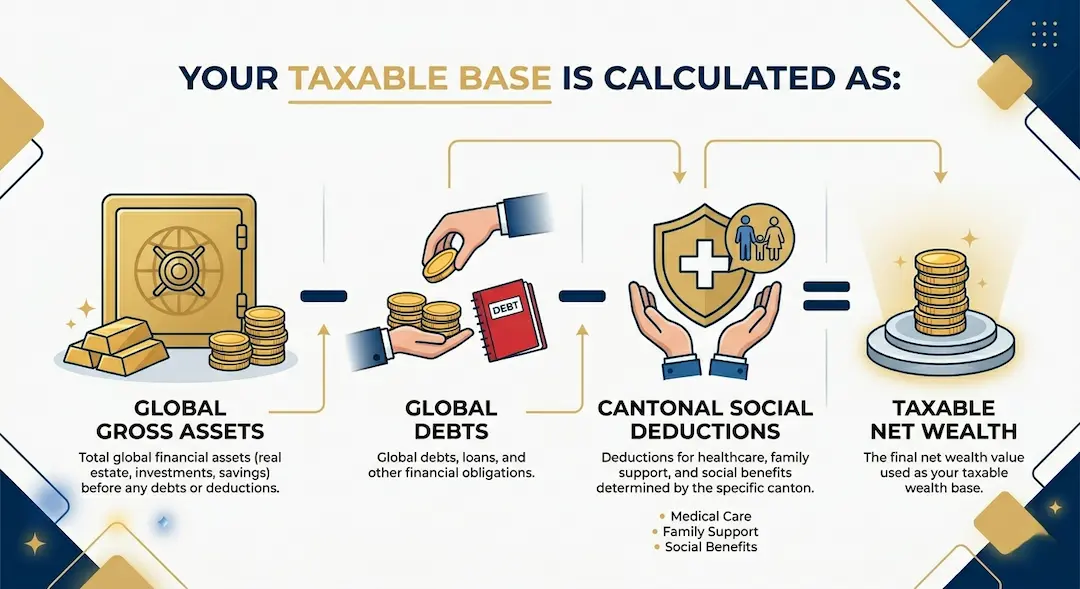
Your taxable base is calculated as:
Global Gross Assets minus Global Debts minus Cantonal Social Deductions equals Taxable Net Wealth.
Wealth tax is a snapshot tax. Authorities assess your net worth based on your exact financial position on 31 December of the tax year.
This makes year-end liquidity management and strategic contributions highly relevant.
| Asset Category | Taxable Status | Valuation Method |
| Bank Accounts & Equities | Taxable | Fair market value as of 31 Dec (official SFTA list). |
| Cryptocurrencies | Taxable | Assessed at the SFTA official year-end rate. |
| Swiss Real Estate | Taxable | Cantonal tax value (historically 60% to 80% of market value). |
| Foreign Real Estate | Exempt* | *Used for rate-determining purposes only. |
| Pillar 2 & 3a Pensions | Exempt | Completely shielded until the point of withdrawal. |
| Household Goods | Exempt | Personal furniture and standard vehicles are generally excluded. |
If you own property in London or a villa in Spain, Switzerland will not tax that real estate directly.
However, the value of those foreign assets is added to your total wealth calculation to determine the progressive tax rate applied to your Swiss assets.
"I frequently see new clients panic about their properties back home. It is vital to understand this 'rate-determining' rule.
Your UK property will not face a direct Swiss tax levy, but it will push your Swiss-based liquidity into a higher tax bracket. This is a crucial distinction we model out during our initial cross-border estate planning phase."
Do You Need Help With Wealth Tax in Switzerland?
Because Wealth Tax in Switzerland is levied locally, your choice of residence is your first line of defence.
The Profile: Flat or very gently progressive rates with high exemption thresholds.
The Reality: Perfect for Ultra-High-Net-Worth Individuals (UHNWIs) where the priority is pure capital preservation. For example, a CHF 5 million portfolio in Zug yields a tax bill of roughly CHF 10,200. In Schwyz, the progression flattens out, making it highly efficient at the top end.
The Profile: Aggressively progressive rates. The wealthier you are, the higher the percentage you pay.
The Reality: A CHF 5 million portfolio in Geneva or Lausanne will attract a tax bill approaching CHF 38,000. However, these cantons offer the “Tax Shield” (Steuerbelastungsmaximum), capping total taxes relative to income. Proper income structuring here is non-negotiable.
The Profile: Moderate exemptions but steep progression for higher brackets.
The Reality: Zurich is relatively forgiving for emerging wealth (under CHF 1 million), but becomes aggressively expensive past the CHF 2 million mark. Here, municipal selection (e.g., Zurich City vs. Küsnacht) makes the biggest impact.
Adjust your estimated taxable net wealth to see the annual tax impact across different regions.
*Figures are illustrative estimates based on a married couple with no children and no church tax. Actual liabilities will vary.
To prevent the confiscation of capital, certain high-tax cantons employ a tax shield.
This mechanism caps your total combined income and wealth tax liability at a specific percentage of your net income (often around 60%).
Proper structuring can trigger this shield, saving substantial amounts annually.
The objective is not tax evasion, but intelligent, compliant asset allocation.
Here are the primary levers you can pull to manage your exposure.
Assets held within the Swiss pension system are entirely exempt from wealth tax until they are withdrawn.
Making voluntary buy-ins to your occupational pension or maximising your annual private pension allowance provides a dual benefit: it reduces your taxable income today and removes that capital from your wealth tax assessment.
Read more about the 2nd Pillar here: What Is the Swiss 2nd Pillar?
Find out more about Pillar 3a here: Pillar 3a in Switzerland
For expats changing jobs or taking a career break, transferring pension assets into a secure holding structure is vital.
These funds remain shielded from wealth tax while continuing to grow.
Swiss real estate is typically taxed at a cantonal value well below the open market price, while mortgages are deducted from your gross wealth at full value.
This structural discrepancy means holding a mortgage can actively suppress your taxable net wealth.
"While the tax code makes holding a large mortgage look incredibly attractive on paper, I always remind my clients that we must not let the tax tail wag the investment dog.
If your portfolio returns are lower than your mortgage interest rate, holding that debt is a net loss, regardless of the wealth tax savings. The mathematics must stack up in the real world."
True, broad-based wealth taxes are globally rare. Only a handful of OECD countries maintain them.
Understanding how the Swiss system interacts with your home country is vital for cross-border planning.
The United Kingdom does not levy an annual wealth tax. Instead, the UK relies heavily on Capital Gains Tax and a punishing 40% Inheritance Tax regime.
If you are navigating the fallout from recent UK legislative changes, proper staging of your exit is critical.
Read our full analysis here: UK Autumn Budget 2025: What It Means for Expats, Residents & High-Net-Worth Clients
"The biggest hurdle for British expats is the mindset shift. In the UK, simply holding an asset is free, but selling it or passing it on triggers a massive tax event.
In Switzerland, the paradigm is inverted. Capital gains on private wealth are generally tax-free, and most cantons have zero inheritance tax for direct descendants.
However, holding the asset incurs this annual wealth charge. You are paying a premium for the privilege of tax-free growth and succession."
Spain is one of the few European nations that actively enforces both a Wealth Tax and a relatively new Solidarity Tax on large fortunes. However, Spanish exemptions vary wildly by region (for example, Madrid versus Andalusia).
If you are planning to relocate between these two jurisdictions, the 31 December valuation date in Switzerland and the 183-day residency rule in Spain can create complex overlap scenarios.
Moving must be meticulously timed to avoid double exposure in a single fiscal year.
For a deep dive into this specific corridor, see our guide: Moving to Spain from Switzerland: A Wealth Management & Tax Guide
No.
Wealth tax is levied exclusively at the cantonal and municipal levels.
Securities are valued at their closing fair market value on 31 December, using the official lists provided by the Swiss Federal Tax Administration (SFTA).
Yes.
Because municipalities apply their own tax multiplier (Steuerfuss) to the cantonal base rate, moving just ten minutes down the road across a municipal border can alter your annual tax bill by thousands of francs.
Everyday household items are exempt.
However, high-value items held explicitly as investments or stores of wealth are technically subject to declaration and taxation.
Understanding Wealth Tax in Switzerland is the first step toward securing your financial future as an expat. The Swiss system rewards proactive, long-term structuring and penalises passive accumulation. The compounding drag of an unoptimised wealth tax can strip years of growth from your portfolio, directly impacting your retirement timeline and legacy planning.
You have the tools available to mitigate this: from leveraging Pillar 2 and 3a accounts to geo-arbitrage and intelligent debt management. However, these strategies must be implemented cohesively.
Are your global assets currently structured to withstand Swiss wealth taxation? Do not wait until the 31 December valuation date approaches.

Get notified about new articles, latest changes and much more