
Global wealth is mobile, but tax systems are not. For high-net-worth families navigating multiple jurisdictions, cross-border estate planning is no longer optional, it is essential infrastructure.
Discover our comprehensive 2026 blueprint detailing the 8 structural pillars of international wealth preservation.
Learn how to manage complex tax residencies, avoid US estate tax traps, navigate forced heirship, and leverage Switzerland as your ultimate neutral coordinating hub.
Read the full guide to safeguard your global legacy.

Global wealth is no longer national. Wealth is mobile, but tax and legal systems are not. Families who treat cross-border architecture as infrastructure preserve empires, but families who treat it as an afterthought lose margin silently.
High-net-worth (HNW) and ultra-high-net-worth (UHNW) families increasingly live in one country, hold operating businesses in another, invest through vehicles in a third, and educate their children across multiple continents. Yet the tax codes, inheritance regimes, and reporting systems governing that wealth remain territorial, fragmented, and politically dynamic.
In 2026, wealth preservation is no longer primarily about outperforming market benchmarks. It is about architecture:
Get the architecture right, and your wealth compounds quietly and efficiently. Get it wrong, and value leaks away through exit taxes, wealth taxes, estate taxes, reporting penalties, and structural friction.
This blueprint outlines proven strategies for tax-efficient structuring, asset protection, and generational transfer tailored for founders, entrepreneurs, and international families. Implementing these can safeguard wealth amid aggressive changes like the UK non-dom abolition and US estate tax adjustments.
Navigating international wealth requires a multidisciplinary approach. In this comprehensive guide, we will cover:
We are living through the most active era of private wealth migration on record. Six- and seven-figure families relocate not merely for tax efficiency, but for a complex matrix of reasons:
At the same time, macro forces have violently reshaped the structural landscape. We are no longer operating in the early 2000s; the environment is hostile to improvised planning. Key shifts include:
For mobile families, the old model, optimise locally and hope everything else “fits”, no longer works. Cross-border estate planning must be genuinely global from day one.
Consider the typical real-world profiles we see managing modern wealth:
On paper, these are immense success stories. In practice, without meticulous cross-border estate planning, they are exposed to something far more dangerous than market volatility: structural misalignment.
Key friction points for these families include:
In 2026, wealth preservation is not about secrecy. It is about intelligent, transparent structure.
To translate theory into reality, let us examine a highly plausible, composite scenario: The Mercer-Schmidt Family.
Klara Schmidt (a German national) built and sold a highly successful med-tech company in Munich.
Following the sale, she and her British husband, David Mercer, relocated to Portugal for the lifestyle, while maintaining a luxury residence in Spain.
They hold a €30m diversified portfolio, heavy in US tech equities and UK commercial real estate. Their two children reside and work in London.
Through deliberate cross-border estate planning, the family establishes a Swiss-based coordination hub.
The US equities are restructured into an Irish UCITS ETF wrapper (legally shifting the situs and neutralising the US estate tax risk).
The Spanish property is leveraged efficiently to minimise net wealth tax exposure.
Finally, they implement harmonised wills with explicit choice-of-law provisions, backed by a UK-compliant life insurance wrapper to provide immediate, tax-free liquidity to their children for the UK IHT liabilities.

Would you like more information about Cross Border Estate Planning?
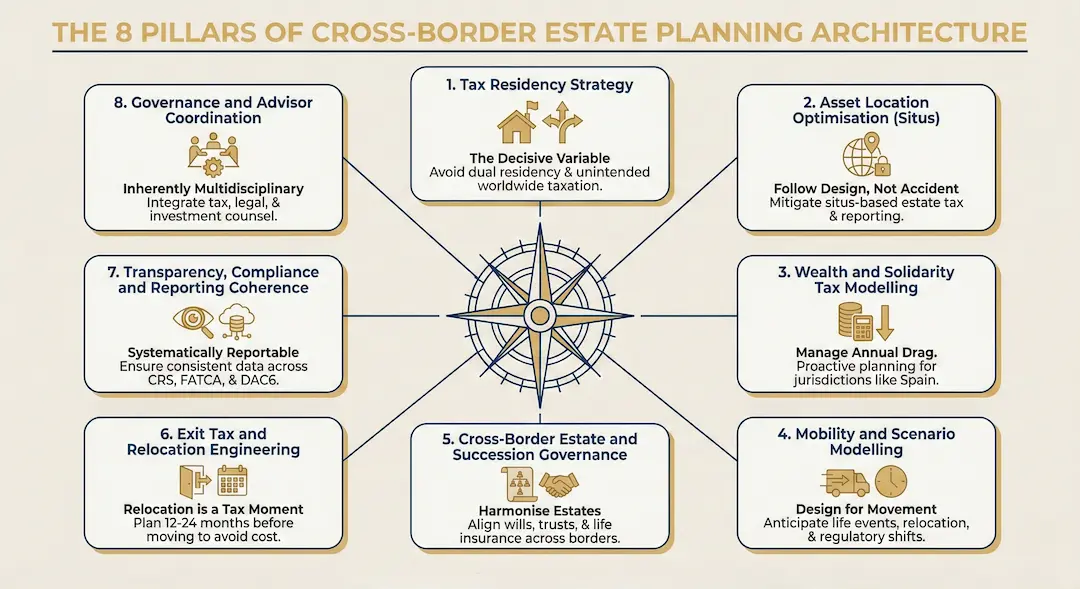
Effective cross-border estate planning relies on eight foundational pillars. Without them, value leaks away.
Your tax liability largely follows where you are considered resident—and sometimes where you are considered domiciled.
For HNW and UHNW families, it is entirely possible to meet residency tests in more than one country in the same year, especially with split years, frequent travel, and multiple homes.
Key determinants include physical presence (day counting), permanent home and “centre of vital interests,” economic and social ties, and treaty tie-breaker rules.
Without an explicit cross-border estate planning residency strategy, you risk dual residence, unexpected worldwide exposure, double taxation, and the loss of preferential regimes.
Switzerland remains one of the world’s most sophisticated cross-border wealth centres. Key characteristics include:
For certain foreign nationals (foreign UHNWIs), lump-sum taxation may be available, subject to federal minimums (CHF 434,700) and higher cantonal thresholds (e.g., Geneva CHF 825,000).
This regime taxes lifestyle expenditure, not worldwide income, but is subject to strict qualification and negotiation. While a cantonal wealth tax applies annually, it is generally predictable and moderate compared to jurisdictions like Spain.
Switzerland functions best as a coordinating hub for multi-bank custody diversification, consolidated reporting, family office governance, illiquid investments (like private equity), and currency diversification (CHF, USD, EUR).
Germany represents the strict face of EU enforcement. Unplanned relocation is particularly dangerous for entrepreneurs here. Exit tax rules on substantial shareholdings, high progressive rates, robust inheritance and gift taxes, and detailed CFC regulations mean that pre-exit planning is absolutely essential to avoid crystallising tax precisely when you seek new flexibility.
Portugal’s regime has evolved from the classic NHR (Non-Habitual Resident) to a more targeted framework, often referred to as NHR 2.0 or IFICI (Incentivised Tax Regime for Scientific Research and Innovation).
NHR 2.0 (IFICI) Highlights | Treatment / Requirement |
Foreign Pensions | 10% flat tax |
Qualified Local Professional Income | 20% flat tax |
Many Foreign Dividends | Often exempt (subject to conditions) |
Duration | 10 years |
Requirement | No Portuguese tax residency in the prior 5 years |
Reforms and EU scrutiny mean planning must reflect current law, not historical assumptions. It is a highly attractive regime, but requires careful structural integration.
Spain offers an exceptional quality of life but imposes a severe administrative and fiscal burden: regional wealth taxes, a national solidarity tax for larger fortunes, and strict forced heirship rules.
For inbound professionals, the Beckham regime provides limited shelter:
Beckham Regime | Treatment / Duration |
Spanish Income | 24% flat rate up to €600,000 |
Foreign Income | Exempt (under regime) |
Wealth Tax | Spanish assets only |
Duration | 6 years |
However, for standard residents holding UHNW portfolios, the wealth tax reality is stark:
Standard Spanish Wealth Tax | Approximate Rates |
Lower bands | ~0.2% |
Upper bands | Up to ~3.5% |
Solidarity surcharge | Applies at higher thresholds |
For families with €20m–€100m+, wealth tax modelling is not optional—it materially affects net return.
Detailed reporting (Modelo 720) and global income taxation upon residency mean Spain requires full wealth modelling before entry.
The UK remains a massive capital markets hub but is no longer a light-touch domicile shelter.
From April 2025, the UK shifts toward a more residence-based model, replacing the remittance basis with a time-limited foreign income and gains framework for new arrivals.
Key shifts for cross-border estate planning in the UK include:
Agricultural/Business Relief Changes (2026):
London property planning often requires life insurance wrappers to provide IHT liquidity.
For British nationals relocating abroad, pre-departure planning around domicile and trust structuring is essential.
The US is structurally unique. It taxes citizens, green card holders, and certain long-term residents on worldwide income regardless of where they live.
US Estate Tax Exposure | Exemption Level |
US Citizens | High exemption (subject to sunset risk post-TCJA) |
Non-Resident Aliens | $60,000 US-situs assets only |
The $60k threshold is critically low and acts as a hidden trap for non-US persons holding US securities directly.
Risks include complex PFIC (Passive Foreign Investment Company) rules on non-US funds, rigorous FBAR and Form 8938 reporting, and potential expatriation taxes upon renunciation of citizenship.
Portfolio design for US persons demands treaty-optimised vehicles, careful fund selection, and blocking structures.
For non-US persons investing in the US, utilizing Irish UCITS ETFs mitigates US estate tax exposure while leveraging a 15% treaty dividend withholding tax. No global structure touching US persons can be improvised.
Where an asset is legally located, its situs, determines which country can tax it on transfer, how withholding applies, and how reporting must be handled.
Consider the friction:
In 2026, asset location must follow deliberate cross-border estate planning design, not historical accident.
For families with significant net worth in Spain, and possibly in other European jurisdictions adopting similar measures, annual wealth and solidarity taxes become a material drag on returns if not modelled early. Annual wealth taxes create structural drag.
In Spain particularly, modelling must rigorously address:
Failure to plan can force asset sales simply to fund annual tax liabilities. Wealth tax influences asset allocation, exit timing, jurisdiction choice, and capital structure. It is a design variable, not a footnote.
Global families do not operate in static environments. Life events, capital events, and political developments continually reshape their geographic footprint. Children leave for universities in London, Boston, or Madrid. Spouses accept board positions abroad. Operating businesses are sold. Governments introduce wealth taxes.
A typical international footprint features exposure defined not by one jurisdiction, but by the interaction between them. Effective cross-border wealth architecture must anticipate movement rather than react to it. It must model:
Structural Vehicles in a Mobile World:
Because assets span jurisdictions, cross-border families rely on layered structures.
Without harmonisation, estates fracture across jurisdictions. For many UHNW families, the silent risk is not within the portfolio, but in the family tree.
Civil law countries (Germany, Spain, Portugal, Switzerland) apply forced heirship rules and reserved shares that limit how much you can leave freely to chosen beneficiaries.
The UK offers testamentary freedom but overlays heavy inheritance tax based on domicile. The US layers federal estate tax and state inheritance rules.
Without proper cross-border estate planning, the results include multiple probates, frozen accounts, double or triple taxation, and contentious litigation between heirs based in different jurisdictions.
Effective governance requires harmonised wills with clear choice-of-law provisions, recognised fiduciary structures, and robust liquidity planning.
Relocation can be the most dangerous tax moment of a wealthy individual’s life.
Moving from one jurisdiction to another, or renouncing a status such as US citizenship, can crystallise latent gains and irrevocably alter estate tax exposure.
Two practical rules apply to cross-border estate planning:
CRS, FATCA, DAC6, and beneficial ownership rules have transformed private wealth from opaque to systematically reportable.
Today, sophisticated planning accepts that multiple financial institutions will report accounts automatically, tax authorities will cross-check data, and banks will demand high standards of due diligence.
For families, the primary risk is inconsistency: structures reported differently across countries, mismatches between tax filings and banking documentation, or informal arrangements that leave unexplained patterns in the data.
A robust compliance architecture ensures that every part of your wealth is documented in a coherent, defensible way across all jurisdictions. Compliance is no longer administrative; it is architectural.
Cross-border wealth management and cross-border estate planning is inherently multidisciplinary.
It spans tax law, corporate structuring, immigration, investment strategy, estate planning, banking, and family governance.
Failure typically arises from siloed advice.
Effective governance requires multi-jurisdictional tax coordination, integrated estate and corporate structuring, banking aligned with tax architecture, and regular structural reviews after relocation or liquidity events.
Would you like A Review Of Your Cross Border Estate Plan?
A practical cross-border estate planning programme follows structured phases to ensure absolute compliance and optimal efficiency:
Many families only discover structural weaknesses during a crisis: an audit, a sale, a divorce, or a succession event. By then, flexibility is limited and remediation costs are staggering.
You require an immediate structural review if:
A cross-border “stress test” evaluates your residency, asset location, estate framework, compliance, and governance, identifying precisely where redesign is required.
Non-US residents are subject to US estate taxes on US-situs assets (like US real estate or direct holdings in US corporations) valued over just $60,000.
To mitigate this, international investors often use structural solutions as part of their cross-border estate planning.
This includes holding US assets through a foreign “blocker” corporation or investing in US markets via Irish-domiciled UCITS funds, which legally shift the situs and generally do not trigger US estate tax exposure.
The “5 by 5” power is a highly specific provision often used in trust planning within common law jurisdictions (like the US).
It permits a trust beneficiary to withdraw the greater of $5,000 or 5% of the trust’s fair market value each year.
This provides the beneficiary with flexible access to capital without causing the entire trust corpus to be included in their taxable estate upon death, maintaining tax efficiency across generations.
The most severe mistakes include:
Wealth management and Estate Planning is no longer primarily about return optimisation. It is about structural optimisation. In 2026, the question is no longer, “Where should I invest?” It is, “Is my wealth engineered to survive borders, relocation, succession, and global transparency?”
For founders, entrepreneurs, and internationally mobile families connected to Switzerland, the EU, the UK, Portugal, Spain, and the United States, cross-border estate planning is core infrastructure, not an optional enhancement.
A high-level engagement maps your global footprint, stress-tests your current structure for residency conflicts and exit risks, designs future-proof architecture, and coordinates your legal and banking counsel into a single strategy.
The right time to design your structure is before your next relocation, a liquidity event, or a generational transfer. Not after.

Get notified about new articles, latest changes and much more