
On March 8 2026, Switzerland votes on individual taxation, marking the potential end of the ‘marriage penalty.’
Discover how the proposed 2026 tax reform will impact your expat household, and why proactive wealth planning is now more critical than ever.
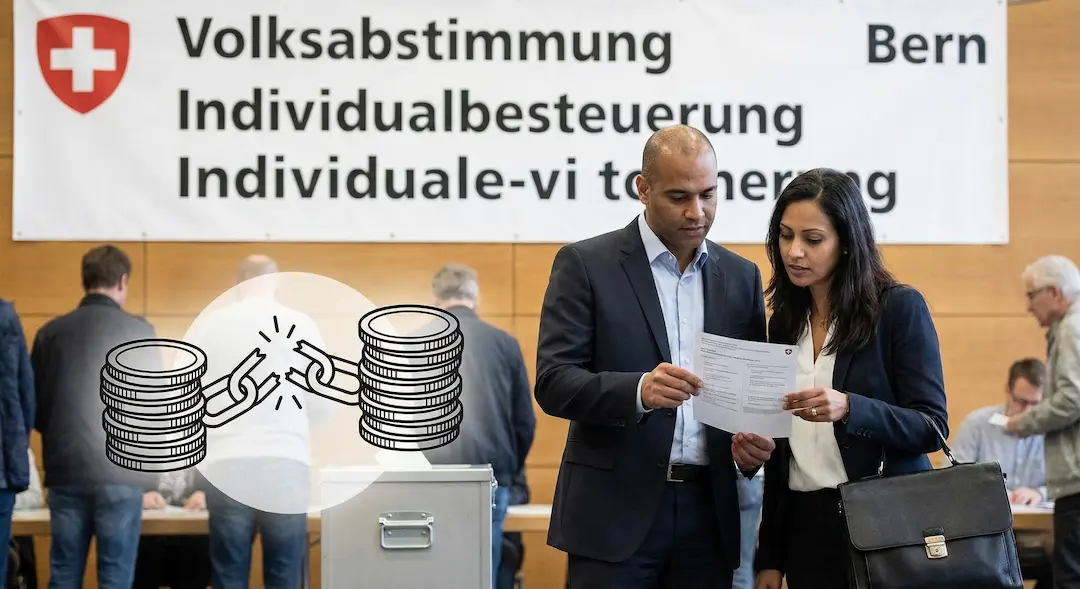
Even though many expats in Switzerland cannot vote, the outcome would still impact on their household finances, career decisions and long-term financial planning.
Today, married couples in Switzerland are taxed jointly. The proposed reform would mean that each adult files and pays taxes individually, regardless of marital status.
For American expats, the debate may sound familiar. In the United States, taxpayers can choose between “married filing jointly” and “married filing separately.”
Switzerland currently offers no such choice, but the reform would move the system closer to the individual-based taxation models used in countries such as the UK or the Nordic states.
One aim is to abolish the so-called “marriage penalty.” Research by economist Nadia Myohl at the University of St. Gallen suggests joint taxation can discourage some cohabiting couples from marrying because combining incomes can push them into higher tax brackets.
To understand the financial impact, one must look at how the Swiss progressive tax system currently operates. Under the joint taxation model, a married couple’s incomes are combined.
For dual-earning married couples, this often pushes the “second” income into a significantly higher tax bracket, creating the “marriage penalty.”
If individual taxation passes, spouses will be assessed separately. This effectively lowers the tax rate for dual-income married couples with similar salaries.
However, to balance the federal budget, the current “married persons” tax rate and specific spousal deductions will be abolished. This means traditional single-earner married couples will likely see their tax bills increase.
Household Structure | Likely Impact | Reason |
Dual-Earner Married Couples (Similar Incomes) | Winner (Lower Tax) | Elimination of the progressive tax penalty on combined high incomes. |
Single-Earner Married Couples | Loser (Higher Tax) | Loss of the current ‘married persons’ rate and spousal deductions. |
Unmarried Couples with Children | Winner (Lower Tax) | Equalised tax rates and access to higher child deductions. |
Dual-Earner Married Couples (Large Income Disparity) | Neutral to Higher Tax | The higher earner loses the smoothing effect of joint assessment. |
"The elimination of the marriage penalty is a double-edged sword for the expat community.
While dual-career couples stand to gain from separated tax brackets, traditional single-earner households, which are very common among relocated senior executives, must prepare for a higher federal tax burden and adjust their wealth preservation strategies accordingly."
Consider “John and Sarah,” an expat couple living in Zurich with two young children. John earns CHF 180,000. Sarah took a career break but is considering returning to work part-time for an offered salary of CHF 70,000.
Under the current system, Sarah’s CHF 70,000 is stacked on top of John’s CHF 180,000. Her income is immediately taxed at their highest joint marginal rate. After deducting childcare costs and taxes, her net financial contribution to the household is negligible, disincentivising her return to the workforce.
Under the proposed individual taxation system, Sarah’s CHF 70,000 would be taxed entirely independently, starting at the lowest tax brackets. Her take-home pay increases dramatically. Conversely, John would be taxed individually on his CHF 180,000. Because he loses the “married” tax discount, his personal tax bill rises slightly, but the household’s overall net income is significantly higher, making Sarah’s return to work highly profitable.
Encouraging marriage itself is not the objective.
As in much of Europe, marriage rates in Switzerland have gradually declined, and policymakers generally view this as a social trend rather than something to reverse.
Instead, policy debates focus on childcare availability, work–life balance, and labour market participation, particularly among women.
The reform could especially affect second earners. Switzerland has one of the highest female part-time employment rates in Europe, and joint taxation can mean the second salary is taxed at a relatively high marginal rate. Government estimates suggest individual taxation could generate up to 44,000 additional full-time equivalent workers, largely through women increasing their working hours. However, economists caution that tax changes do not always lead to dramatic labour-market shifts.
Alongside tax reform, organisations are also working to reconnect women with the workforce. Companies such as UBS run return-to-work programmes for professionals after career breaks. The University of St. Gallen offers its Women Back to Business programme, while initiatives such as Advance and Bring Women Back to Work provide mentoring, training and reskilling opportunities.
If the law passes, the transition will not happen overnight.
Because all 26 cantons must adapt their individual tax laws, full implementation is not expected until 2032. This provides a vital, multi-year runway for expats to restructure their finances.
A major feature of the reform is the child deduction. To offset the loss of joint tax benefits, the proposal includes increasing the child deduction for direct federal tax from CHF 6,700 to CHF 12,000 per child.
Crucially, under the new law, this deduction would be split equally between both parents’ individual tax returns.
"Individual taxation completely rewrites the playbook for capital withdrawals.
Currently, if spouses withdraw from their Pillar 2 or Pillar 3a accounts in the same year, the amounts are aggregated, pushing them into a higher tax bracket.
The new law will allow spouses to stagger and split withdrawals far more efficiently, resulting in substantial tax savings at retirement."
The reform would not directly change Switzerland’s pension system, including the Old-Age and Survivors’ Insurance (AHV/AVS).
Contributions remain individual and are based on income, not tax filing status. However, if more women work or increase their hours, they would contribute more to the system and potentially build stronger individual pensions over time.
Existing protections, such as pension splitting between spouses and childcare credits, would remain unchanged.
"With the potential for increased tax liabilities for single-earner households, proactive capital deployment is essential.
We strongly advise clients holding unallocated annual bonuses to review their occupational pension (Pillar 2) buy-in capacity and maximise Pillar 3a contributions to legally offset taxable income before the cantonal laws shift."
It depends entirely on your household income structure, not your nationality.
Dual-earning households with similar incomes will generally pay less Swiss tax, while single-earner households will likely pay more.
US expats will still need to file with the IRS, but the amount of foreign tax credits generated in Switzerland will shift based on these new individual assessments.
If passed, the law will increase the child deduction for direct federal tax from CHF 6,700 to CHF 12,000 per child.
Because taxation will be individual, this CHF 12,000 deduction will be split equally (CHF 6,000 each) between the parents’ separate tax returns.
While the vote takes place in March 2026, the changes will not be immediate.
Due to the complexity of harmonising the tax codes across all 26 Swiss cantons, the Federal Council plans for the law to come into full effect in 2032.
Beyond taxes, the referendum touches on broader questions: how Switzerland balances tax fairness, family structures, workforce participation and the sustainability of its pension system.
Even if you cannot vote, it’s a debate that will shape the financial landscape for expat households in Switzerland for years to come.
However, a robust wealth strategy must remain proactive, regardless of the political landscape. Do not wait for cantonal tax laws to rewrite your financial plan.

Get notified about new articles, latest changes and much more